

SmartBio: Smart IoT-Driven Decarbonisation of Compost Manufacturing
-
SmartBio is a 9-month innovation project funded under the 1st GreenMantis Innovation Open Call, an EU programme that supports green manufacturing and net-zero technologies in European SMEs. It brings real-time digital monitoring to compost manufacturing at ASSEA Bioenergy’s open-windrow composting facility on Kos, Greece.
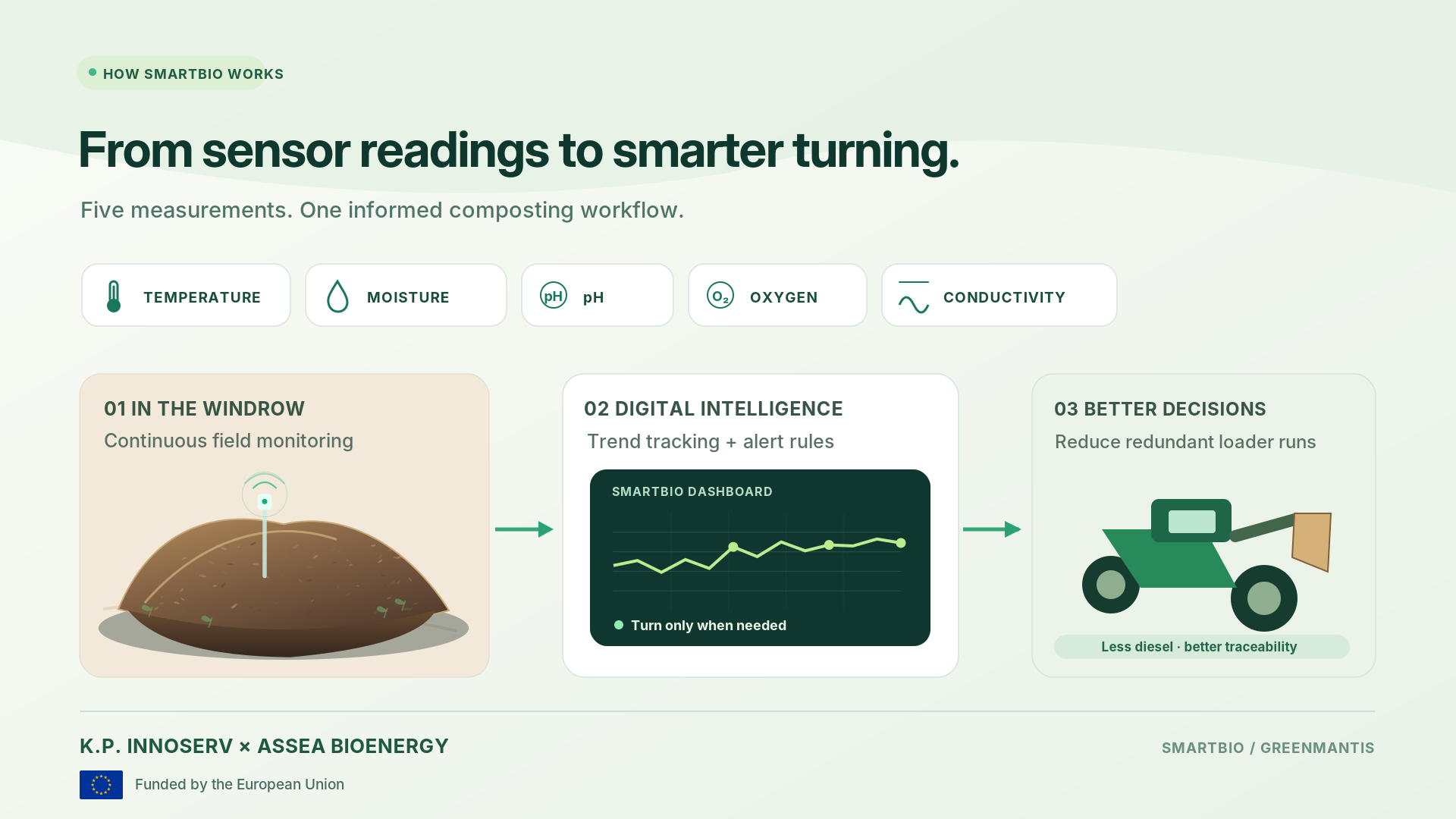
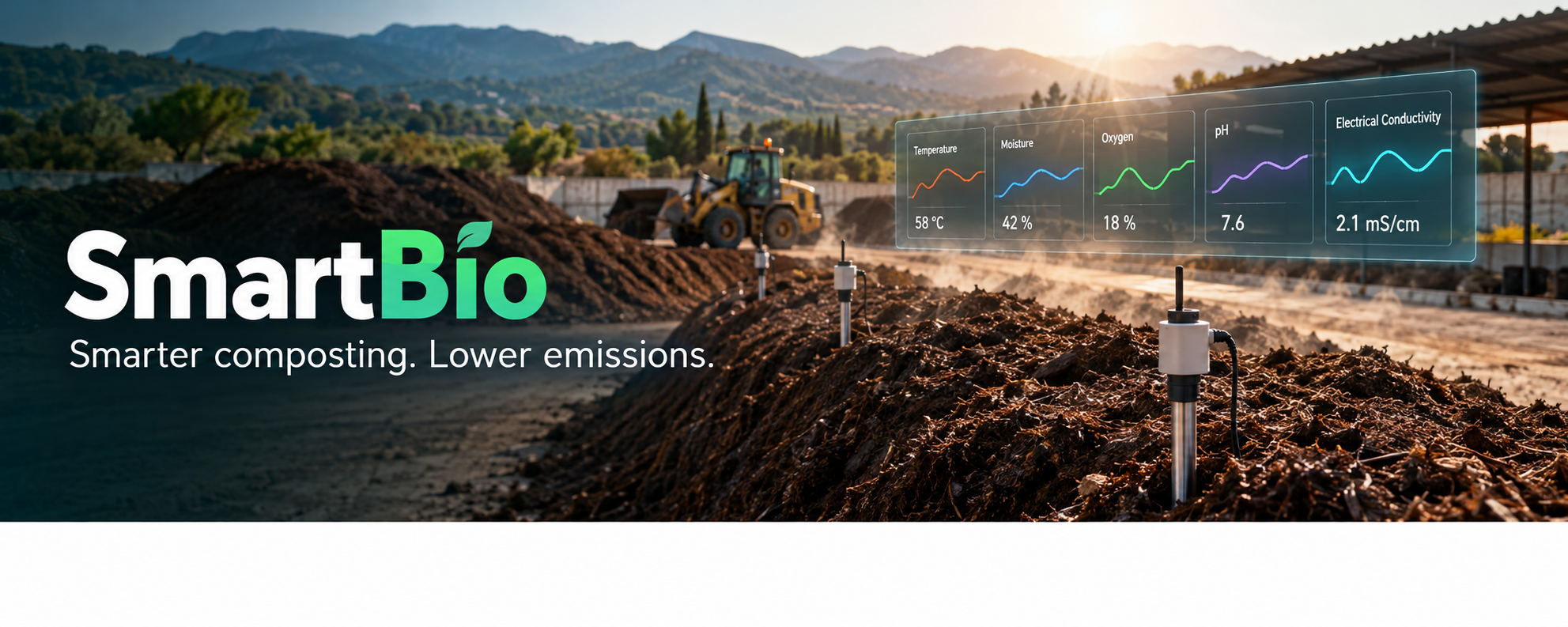
Today, compost windrows are turned with a diesel loader on a fixed calendar schedule, whether the biological process needs it or not. SmartBio replaces this with a five-parameter IoT sensor network (temperature, moisture, pH, oxygen and electrical conductivity) feeding a real-time dashboard and rule-based alert engine, so the piles are turned only when the data shows it is needed.
The project targets a 10–25% reduction in loader diesel use and a 5–10% cut in CO₂ emissions per batch. Every batch also receives an automatically generated Batch Monitoring Report, turning ASSEA’s compost into a digitally verified, data-backed product. The system is modular and designed for replication across Europe’s composting sector.
-
K. P. INNOSERV LTD is the project coordinator and technology lead of SmartBio. We specify and build the SmartBio monitoring system, from sensor selection and the wireless data pipeline to the dashboard and alert logic, supervise its installation on site, and train ASSEA’s operators on the new sensor-alert turning protocol.
We also analyse the pilot data to validate the energy and CO₂ savings against the measured baseline, lead the project’s reporting to GreenMantis, and develop SmartBio into a scalable monitoring service for composting facilities across Europe.
-
K. P. INNOSERV LTD (Nicosia, Cyprus) – Coordinator and technology lead
ASSEA BIOENERGY (Kos, Greece) – Compost producer and pilot site



Funded by the European Union. Views and opinions expressed are however those of the author(s) only and do not necessarily reflect those of the European Union or the European Innovation Council and SMEs Executive Agency (EISMEA). Neither the European Union nor the granting authority can be held responsible for them.